High-quality metrology for quality control in the measuring room, production, incoming goods and development.
Gear Metering Pumps & Meter Mix Dispense Machines with highest accuracy for processing liquids and pastes.
High-precision rotary stroke bearings for backlash-free linear and rotational movements for use in machine and device construction.


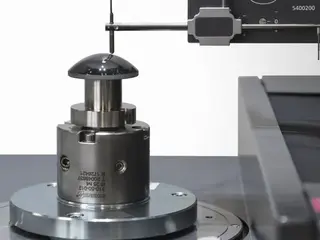

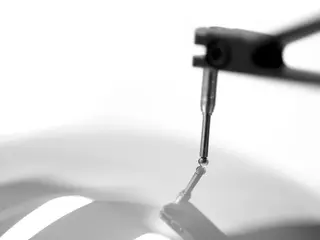
Innovative metrology for a wide range of applications:
- • Length and diameter
- • Surface and contour
- • Form and position
- • Gears and shafts

Precise mixing and metering of liquids and pastes:
- • Gear metering pumps
- • Pumps for fiber production
- • Meter mix dispense machines as well as mixing heads

Rotary stroke bearings for backlash-free linear and rotary movements in:
- • Mechanical engineering
- • Precision engineering
- • Optik
- • Electronics
- • and many other industries


As an internationally active company, Mahr holds its patents not only in Germany, but worldwide.

Automated measuring with industrial robot
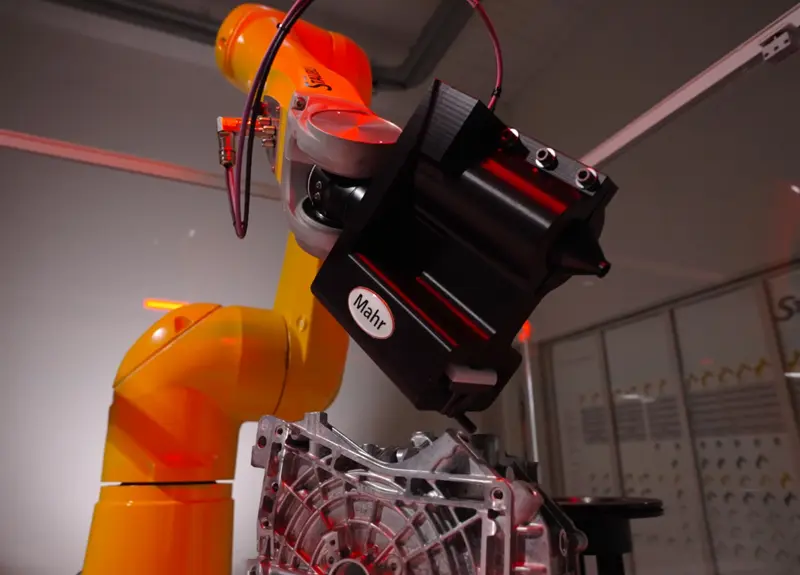
This prototype combines a Stäubli robot with two different devices for optical and tactile roughness analysis. Future customers will benefit from the automation of reliable measurement results due to secure repeatability and reduced operator intervention.
Specifically, the study combines a Stäubli TX2 90 six-axis industrial robot with an OptoSurf OS 500 sensor for optical analysis and a MarSurf M 310 device for tactile roughness analysis. The OS 500 sensor determines Aq parameters* and is used to verify functional surfaces, while the tactile M 310 device checks various conventional roughness parameters. Car brake discs and electric motor housing are used as examples of workpieces.
Robots as part of the measurement solution
The following video shows how the combination works:
The Stäubli industrial robot positions the required device at the desired location on the component. Once the correct position has been reached, the measurement begins. When using the MarSurf M 310, the robot remains in a fixed position while the tactile device performs mobile measurements. During optical measurement with the OptoSurf OS 500, on the other hand, the robot moves to guide the sensor across the surface.
New concept – comprehensive user benefits
The combination of robotics and production metrology opens up a whole new range of applications for customers: the powerful robot not only serves as a tool for loading and unloading workpieces, but also as an active component of the measurement solution itself. The robot's movements replace various devices that users normally employ to position their workpieces correctly. This significantly reduces the complexity of reaching all measurement points. In addition, the solution can operate around the clock, which reduces personnel costs while increasing productivity. Ultimately, the combination of both technologies simplifies the entire measurement chain – and fewer steps and operator interventions mean fewer sources of error and, in turn, more reliable measurement results.
*The Aq parameter is a characteristic value in optical surface metrology in the context of scattered light technology. It is used to evaluate the microstructure of a component and describes the intensity of the scattered light distribution.
Find out more about the products of our cooperation:
- All details about the industrial robot TX2 90 can be foundon the Stäubli website.
- Click here for the OptoSurf portfolio.
- On our website you will find more information about the MarSurf M 310.
- You can order the MarSurf M 310 directly in the Mahr online store.